Inconel 718 does not have one universal hardness value. For bar procurement, a hardness requirement is meaningful only when it identifies the delivery condition, test scale and applicable specification. Solution-treated material intended for subsequent fabrication should not be judged against an aged-bar requirement without checking the order and governing standard.
This guide helps buyers specify UNS N07718 bar, review hardness reports and resolve unexpected readings before accepting or rejecting a shipment.
Why the delivery condition comes before the hardness number
Inconel 718 is a precipitation-hardenable nickel alloy. Its condition matters: material supplied for machining and later heat treatment serves a different purchasing purpose from material supplied after aging. The Special Metals 718 technical bulletin describes fabrication in a relatively malleable condition followed by specification-controlled heat treatment. It also presents multiple heat-treatment routes rather than one recipe for every application.
- Solution-treated or annealed bar: clarify whether final aging will be performed after machining and who is responsible for it.
- Aged bar: specify the required final condition and associated mechanical-property acceptance requirements.
- Cold-worked material: record the processing condition instead of treating an elevated reading as proof of aging.
The practical question is not “Is 718 hard enough?” but “Does this bar meet the agreed requirements in its ordered condition?”
HRC, HB and HV: what must appear on the report?
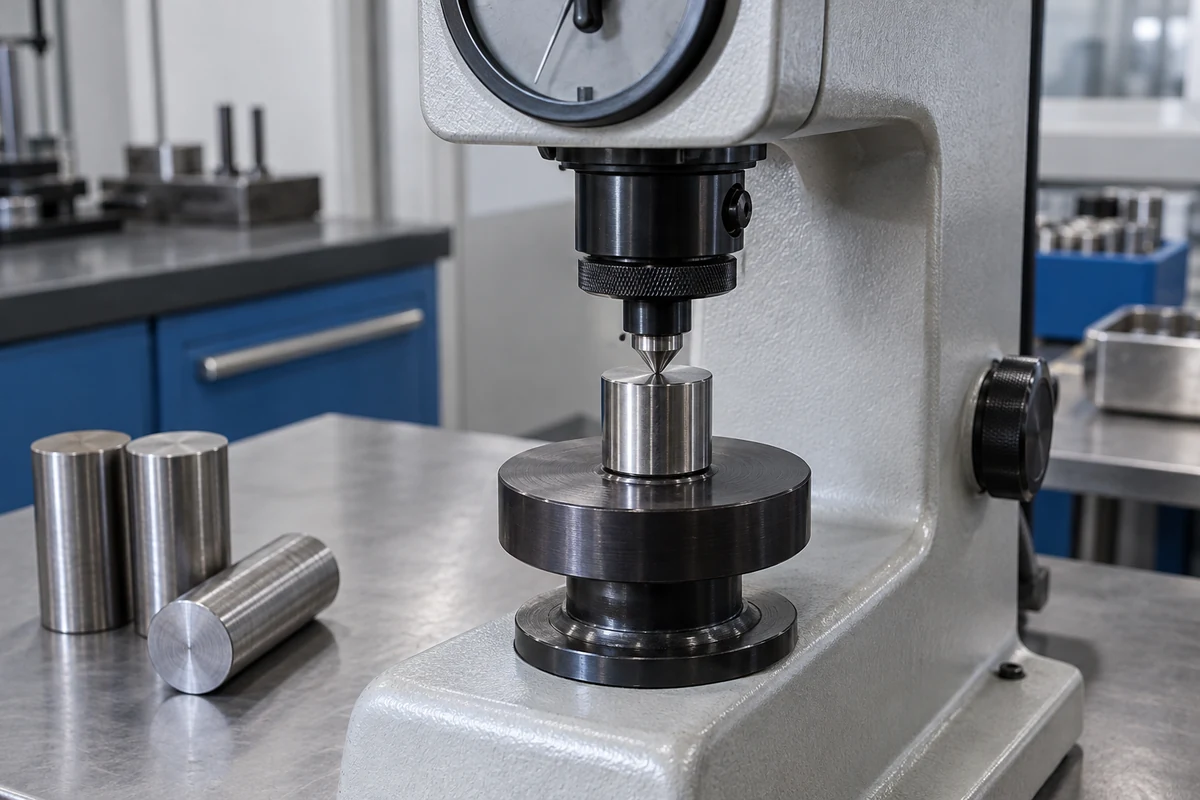
A figure labelled only “hardness 35” is incomplete. Ask for the method, scale, specimen condition and test location. HRC denotes Rockwell C; HB/HBW denotes Brinell reporting; HV denotes Vickers reporting. Do not compare their numerical values directly or silently substitute a converted result for an original measurement.
The public scope of ASTM E18 covers Rockwell testing and identifies specimen thickness and convex cylindrical surface corrections as relevant subjects. Its significance section also cautions that one test location may not represent an entire part. For a round bar, therefore, the tested surface and sampling plan deserve attention—not just the reported number.
Five checks before rejecting an Inconel 718 bar
1. Match the certificate to the ordered condition
Compare the purchase order, heat identification and treatment record. Establish whether the bar was supplied before or after final aging. A delivery-condition mismatch needs clarification before numerical comparison.
2. Identify the controlling requirement
Use the specified product standard, revision, drawing and supplementary requirements. The public ASTM B637 scope includes precipitation-hardening nickel-alloy bars and forgings, with mechanical testing addressed in its abstract. That does not establish one hardness limit for every 718 order. Obtain the applicable acceptance clause rather than borrowing a value from another product form.
3. Verify the method and scale
Request the original readings, method and scale. If a report contains a converted value, ask which original measurement and conversion basis produced it.
4. Review the specimen and test location
Ask whether testing used a prepared flat specimen or a curved bar surface, and how the selected procedure handled the geometry. Agree on representative locations and the retest procedure with the responsible laboratory.
5. Reconcile the full evidence
Review the hardness results alongside the required tensile results, treatment documentation and traceable material certificate. Keep suspect material identified while the discrepancy is investigated. Do not replace the original records with a single favourable retest.
Standard limits, typical values and measured results are different
- Standard requirement: an acceptance limit from the governing order specification.
- Typical value: reference information tied to a stated product and processing condition; not a shipment guarantee.
- Measured result: a documented reading tied to a specimen, heat or lot and test procedure.
A catalogue value cannot replace a missing test result. A satisfactory hardness reading also cannot, by itself, establish chemical identity or approve a component for sour service.
What to include in your Inconel 718 bar enquiry
Send the following information so the proposed supply condition and testing scope can be checked before quotation:
- UNS N07718 / Inconel 718, bar diameter, length and quantity.
- Required product standard and revision, plus any drawing requirements.
- Delivery condition and responsibility for final heat treatment.
- Hardness range or limit, scale, method and acceptance reference, if required.
- Sampling locations, certificate requirements and destination.
If the hardness requirement is not yet defined, provide the application and governing specification; do not insert a guessed range. Availability, processing and inspection scope require confirmation for the individual enquiry.
Check the bar first—or send your specification now
Explore the Inconel 718 bar page for product information. If your dimensions and delivery condition are already defined, send them directly with your inspection requirements.
Post time: Sep-17-2026