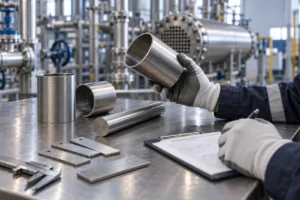
Compare Inconel 625 and Hastelloy C276 for acids, chlorides, seawater, fabrication and procurement. Use service conditions—not alloy reputation—to choose the right nickel alloy. Read more »
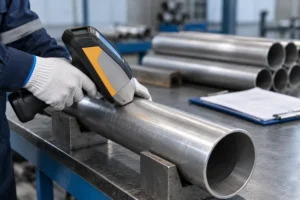
An XRF grade match cannot fully verify Incoloy 800H or 800HT. Learn which chemistry, heat-treatment and traceability evidence pipe buyers should check. Read more »
Practical starting parameters for machining Inconel 625 and 718, including cutting speed, feed, tooling, coolant, work hardening control and process adjustments. Read more »
A flange Class is not a fixed pressure. ASME B16.5 pressure–temperature rating depends on material group, temperature and class; the complete joint may be limited by bolting or gasket. Read more »
NACE MR0175 / ISO 15156 governs cracking-resistant materials for H2S-containing oil and gas production. Alloy name alone is not compliance: limits, condition, hardness and documentation matter. Read more »
Solution-annealed Inconel 718 is easier to form and machine; aged 718 develops high strength through gamma-prime and gamma-double-prime precipitation. Compare conditions and specifications. Read more »
UNS N06625 identifies Alloy 625 chemistry, while 2.4856 and NiCr22Mo9Nb are commonly corresponding European designations. Product standards and conditions are not interchangeable. Read more »
Inconel 625 has no single allowable temperature. Oxidation capability, pressure-code allowable stress, corrosion, creep, condition and joint design must all be checked. Read more »
For hydrochloric acid, C276 generally provides a wider corrosion-resistance envelope than Alloy 625, but concentration, temperature, aeration and contaminants must be reviewed before selection. Read more »
A practical guide to ASTM B443 Alloy 625 plate, sheet and strip sizes, thickness tolerance, width, length, flatness and the details buyers should state in an RFQ. Read more »
ASTM B444 covers cold-worked seamless Alloy 625 pipe and tube, while ASTM B705 covers welded nickel-alloy pipe. Compare manufacturing route, testing, dimensions and purchasing requirements. Read more »
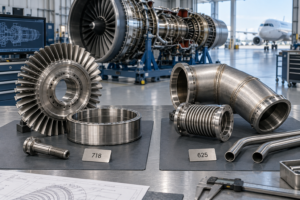
Compare Inconel 718 and Inconel 625 for aerospace applications, including strength, temperature capability, corrosion resistance, welding, heat treatment and typical uses. Read more »