Quick answer: No. A handheld XRF PMI grade match alone cannot confirm Incoloy 800H or 800HT. It helps check alloy identity, but does not establish carbon content or metallurgical condition. For pipe and tube acceptance, connect the instrument result to the ordered UNS grade, heat-linked material certificate and required processing/test records.
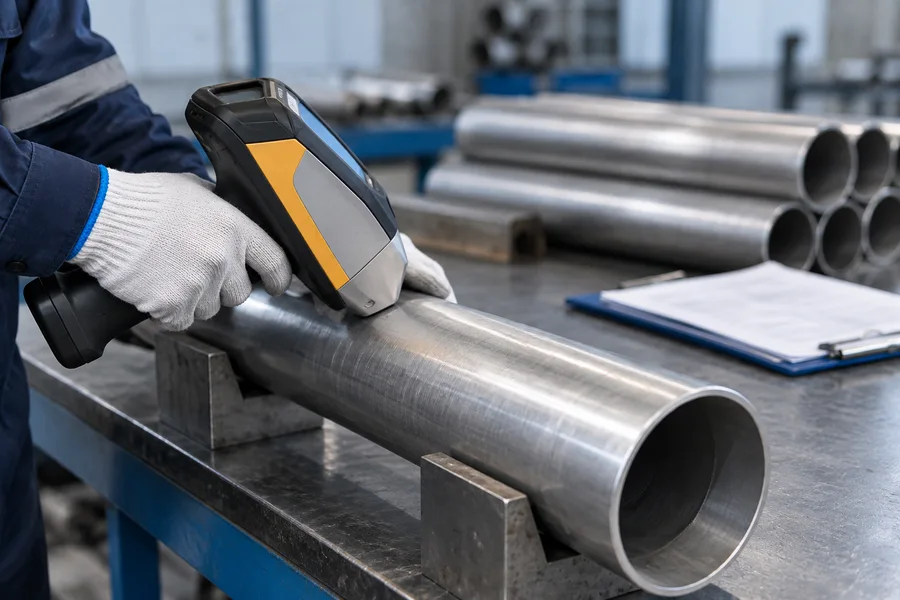
A receiving inspector may see an 800-family grade on the analyzer while the purchase order calls for 800HT. That is a reason to examine the evidence, not automatically reject the shipment or approve it. The practical question is: what has been verified, and what is still unproven?
What the XRF result actually establishes
Positive material identification (PMI) is a verification task, not one universal test method. Handheld X-ray fluorescence (XRF) is useful for checking measurable alloying elements. Its displayed grade is a library match based on those measurements; the label should not be treated as a certificate covering every purchase requirement.
XRF cannot measure carbon. Optical emission spectroscopy (OES) can measure carbon when the instrument, calibration and procedure suit the material. These are distinct analytical capabilities, as explained in Thermo Fisher Scientific's comparison of PMI technologies. Request the actual measured elements and method, rather than only a photograph of the grade name.
Why 800H and 800HT need additional evidence
The 800 family has overlapping nickel, chromium and iron limits. Special Metals publishes the following chemistry distinctions, expressed as mass percentages:
- 800, UNS N08800: carbon up to 0.10%, without a specified minimum in the manufacturer's comparison.
- 800H, UNS N08810: carbon 0.05–0.10%.
- 800HT, UNS N08811: carbon 0.06–0.10%, with combined aluminum plus titanium of 0.85–1.20%.
The manufacturer's bulletin also associates 800H/800HT with high-temperature annealing and an average grain size of ASTM No. 5 or coarser. Chemistry alone does not establish that condition. See the Special Metals 800H/800HT technical bulletin, pages 1–2.
Acceptance note: These are manufacturer-published reference limits, not test results for a particular shipment. Use the contracted product specification, edition and project requirements for acceptance. Do not convert a matching composition into an unsupported grade upgrade.
Grain size requires its own measurement
An alloy chemistry reading does not measure grain structure. ASTM E112 describes metallographic procedures for determining average grain size, including comparison, planimetric and intercept methods. Its test methods do not themselves establish a material's fitness for service. The required acceptance limit comes from the applicable material specification or project requirement. See ASTM E112's published scope and significance; use the edition required by the order.
Pipe and tube: decide what can move forward
For buyers reviewing Incoloy 800/800H/800HT pipe and tube, distinguish a broad product-family listing from the exact grade being offered. ASTM B407 covers annealed seamless pipe and tube, including N08810 and N08811, with requirements beyond chemistry. Its scope does not establish compliance for a welded product. Refer to the ASTM B407 specification summary.
1. Evidence agrees: continue the inspection
The ordered UNS designation, pipe markings and heat certificate agree; required chemistry and processing evidence are available; PMI results support the identity check. Continue the remaining dimensional, surface, mechanical and specified test checks. A satisfactory PMI result is one completed check, not the release of the entire order.
2. Evidence is incomplete: request the missing record
The analyzer is consistent with the alloy family, but the certificate omits a required result or the heat-treatment record cannot be linked to the supplied material. Keep acceptance pending. Request the specific missing evidence for that heat or lot. Repeating the same XRF measurement cannot answer a different, unmeasured requirement.
3. Evidence conflicts: hold and resolve the discrepancy
A marking identifies a different heat, the certified grade differs from the order, or a required result falls outside the acceptance criteria. Segregate the affected material under your quality procedure and ask for a documented resolution. Do not relabel the pipe or approve a substitution based only on appearance or a handheld grade label.
Example: an 800HT order with an incomplete certificate
Illustrative receiving scenario, not a reported customer case: The order specifies N08811 seamless tube. The supplied XRF report shows an 800-family match, while the certificate has no carbon result and no traceable record addressing the required metallurgical condition.
The defensible status is “verification incomplete.” Ask the supplier for the original heat-linked records. If these cannot resolve the gap, agree with the responsible quality or materials engineer on suitable additional testing and its acceptance criteria. Even a new chemistry test does not reconstruct missing manufacturing history or automatically authorize recertification.
Keep the purchase requirement, actual result and disposition in separate fields. This makes it clear whether a number is a specified limit, a measured value or information that has not yet been provided.
Questions to resolve before accepting the shipment
Does a matching grade name mean every item was tested?
No. Review the recorded item identification and test coverage. One result cannot establish the identity of untested pieces, particularly if bundles contain multiple heats. Agree sampling or individual-item coverage through the purchase and inspection requirements.
Should material be rejected when the instrument shows only “800”?
Not on that label alone. Review the measured chemistry, instrument library and supporting documents against the ordered grade. A generic library label can leave the question unresolved without proving the material is wrong.
Is “dual certified” enough on a quotation?
Treat it as a statement that needs supporting documentation. Ask which grades, specification editions and supplied condition the certification covers. Confirm that the records apply to the actual heat and product form before accepting the wording.
Need to clarify an 800H/800HT pipe requirement?
Send SASAALLOY the ordered UNS grade, product form and the specific certificate or PMI question, together with your pipe dimensions and quantity. State any required inspection documents in the enquiry so their availability and scope can be confirmed in the quotation.
Post time: Sep-14-2026