Nickel alloy sheet and plate are often ordered with short descriptions such as “annealed and pickled” or “bright annealed.” These descriptions are useful, but they do not all refer to the same stage of manufacture. A complete purchasing specification should separate the rolling route, heat-treatment condition, oxide-removal method and any final mechanical finish.
Nickel Alloy Surface Conditions at a Glance
The following table provides a practical first comparison. Availability must still be confirmed for the selected alloy, thickness, width and governing product specification.
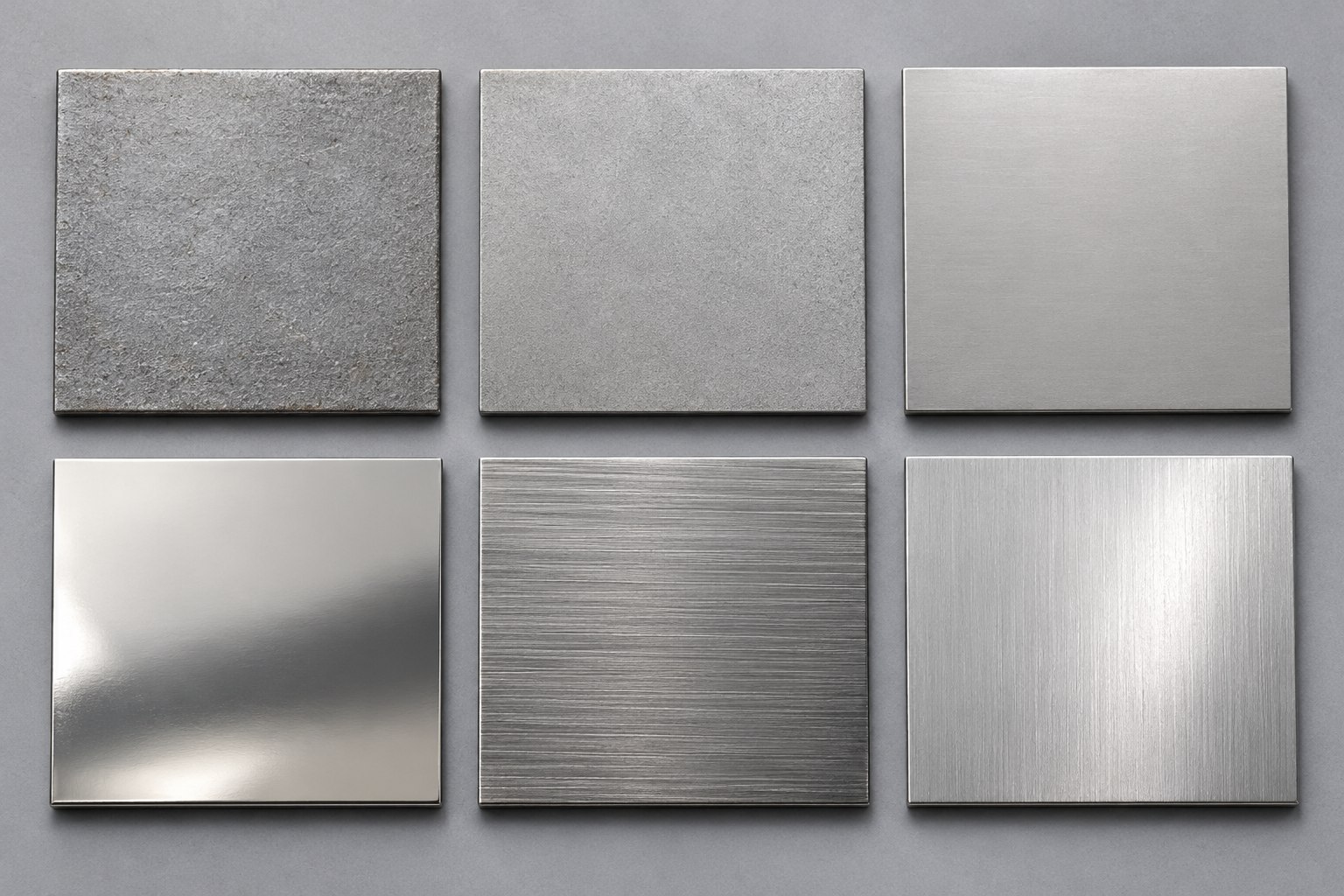
| Top left Hot rolled, annealed and descaled |
Top center Hot rolled, solution annealed and pickled |
Top right Cold rolled, annealed and pickled |
| Bottom left Cold rolled and bright annealed |
Bottom center Cold worked / hard rolled |
Bottom right Ground or polished |
| Surface condition | Typical product form | Rolling route | Heat treatment | Final surface step | General appearance |
|---|---|---|---|---|---|
| Hot rolled, annealed and descaled | Plate; heavier sheet | Hot rolled | Annealed or solution annealed as required | Scale removal | Matte, functional mill surface; rolling texture may remain visible |
| Hot rolled, solution annealed and pickled | Plate | Hot rolled | Solution annealed | Chemical pickling | Clean, matte industrial surface; not equivalent to polishing |
| Cold rolled, annealed and pickled | Sheet, strip and light plate | Cold rolled | Annealed | Chemical pickling | Smoother and more uniform than a typical hot-rolled surface |
| Cold rolled and bright annealed | Sheet and strip | Cold rolled | Annealed in a controlled atmosphere | Normally no heavy post-anneal scale removal | Clean and relatively bright; appearance depends on the alloy and process |
| Cold worked / hard rolled | Strip and thin sheet | Cold rolled to the required condition | Defined by the ordered temper or condition | As agreed | Uniform mill surface; mechanical properties take priority over decorative appearance |
| Ground or polished | Sheet and plate | Any suitable base route | Base material condition must be stated separately | Abrasive grinding or polishing | Controlled directional or smoother finish when acceptance requirements are specified |
Manufacturing Condition and Final Finish Are Different
A single phrase can otherwise combine several unrelated requirements. The table below shows what each term actually controls.
| Term in an RFQ | What it describes | What it does not define by itself | Recommended additional information |
|---|---|---|---|
| Hot rolled / cold rolled | How thickness was reduced | Final heat treatment, oxide removal or roughness | Required material condition and final surface treatment |
| Annealed / solution annealed | Heat-treatment condition | Whether scale was removed or a visual finish was applied | Descaled, pickled, bright annealed, ground or polished as applicable |
| Descaled / pickled | Removal of heat-treatment oxide and surface contamination | A decorative finish or a guaranteed roughness | Permitted discoloration, pits, scratches and any roughness limit |
| Bright annealed | Controlled-atmosphere annealing intended to limit oxidation | A universal gloss level for every alloy and gauge | Visual sample, reflectivity or roughness requirement if appearance is critical |
| Ground / polished | Secondary abrasive finishing | Base alloy condition or dimensional tolerance | Grit sequence or Ra, direction, treated side and protective-film requirement |
Hot-Rolled Plate Surface Comparison
| Condition | Surface and oxide state | Common purchasing use | Buyer should verify |
|---|---|---|---|
| As hot rolled | Mill scale and rolling marks may remain | Intermediate processing when subsequent heat treatment or cleaning is planned | Whether this is permitted by the product specification and fabrication route |
| Hot rolled + annealed | Heat-treatment oxide may remain unless cleaning is separately specified | Material condition established before further surface processing | Whether descaling or pickling is included |
| Hot rolled + annealed + descaled | Heavy scale removed; matte mill texture may remain | Industrial plate for fabrication and corrosion-service components | Residual scale, pits, scratches, flatness and edge condition |
| Hot rolled + solution annealed + pickled | Oxide chemically removed after heat treatment | Clean functional plate surface prior to forming, welding or machining | Pickling practice, surface-defect limits and whether further finishing is required |
Cold-Rolled Sheet and Strip Surface Comparison
| Condition | Typical characteristics | Suitable purchasing focus | Points to state clearly |
|---|---|---|---|
| Cold rolled, annealed and pickled | Closer thickness control and a smoother mill surface than typical hot-rolled plate | Fabricated sheet components, liners and corrosion-resistant equipment | Thickness tolerance, surface-defect limits, one-side/two-side inspection |
| Cold rolled and bright annealed | Clean, relatively bright surface produced by controlled-atmosphere annealing | Thin-gauge parts where cleanliness and a smoother appearance matter | Availability by alloy/gauge, visual sample and protective film |
| Cold worked / hard rolled | Strength and temper are influenced by retained cold work | Strip applications ordered to a defined mechanical condition | Temper or mechanical-property requirement, grain direction and flatness |
| Cold rolled + ground/polished | Base mill surface receives a secondary abrasive finish | Parts requiring controlled roughness or directional appearance | Base condition, grit/Ra, finish direction and treated face |
Mechanical Finish Parameters to Put on the Purchase Order
Words such as “polished” or “smooth” are not measurable acceptance criteria. When surface finish affects sealing, cleaning, coating, forming or appearance, add the relevant parameters below.
| Finish type | Main parameter | Additional acceptance item | Typical specification wording |
|---|---|---|---|
| Ground | Abrasive grit sequence or target Ra | Grinding direction; one or both sides | “Ground on both faces to the agreed Ra; longitudinal grain.” |
| Directional brushed | Reference sample or agreed abrasive | Direction consistency and allowable cross-scratches | “Uniform longitudinal finish to approved sample.” |
| Polished | Target Ra and/or approved visual sample | Gloss, waviness, pits and isolated scratches | “Polished on the designated face to agreed Ra and visual standard.” |
| Machined surface | Ra/Rz if required | Measurement direction and location | “Ra measured transverse to tool marks at the indicated locations.” |
| Protected finished surface | Film type and removable adhesive requirement | Which face is protected and removal timing | “Finished face protected with removable film suitable for shipment and forming.” |
Surface Acceptance: Which Parameters Matter?
| Acceptance item | Why it matters | How to make it measurable |
|---|---|---|
| Ra (arithmetical mean roughness) | Commonly used to control functional surface texture | State the maximum or range, units, cutoff/method and measurement locations |
| Rz or another profile parameter | May reveal peak-to-valley behavior not represented by Ra alone | Use only when needed and identify the governing measurement method |
| Visual appearance | Two surfaces with similar Ra can still look different | Approve a reference sample or define lighting, viewing distance and defect limits |
| Grain direction | Affects appearance and may influence later fabrication | Specify longitudinal, transverse or non-directional finish |
| Surface defects | Pits, laps, deep scratches and embedded contamination can affect downstream use | Define permitted type, size, depth, frequency and repair method |
| Inspection face | One face may be functional while the reverse face has different requirements | Identify one side, both sides or a marked critical face |
Common Nickel Alloy Product Specifications
The standard establishes the product and material requirements, but the purchase order may still need additional surface acceptance details. Always verify the applicable edition and project specification.
| Alloy family | UNS designation | Common sheet/plate/strip specification | Surface note |
|---|---|---|---|
| Alloy 625 sheet and plate | N06625 | ASTM B443 | State the required material condition and any additional cleaning or mechanical finish |
| Alloy C276 sheet and plate | N10276 | ASTM B575 | Confirm annealed condition, product form and agreed surface acceptance |
| Alloy 600 | N06600 | ASTM B168 | Do not infer finish only from the alloy designation |
| Alloy 825 | N08825 | ASTM B424 | Define pickled, descaled or mechanically finished condition as required |
| Nickel-copper Alloy 400 | N04400 | ASTM B127 | Match finish requirements to product form and downstream fabrication |
| Nickel 200 / Nickel 201 | N02200 / N02201 | ASTM B162 | Specify surface and inspection requirements separately from grade |
How Stainless Finish Names Translate to Nickel Alloy Purchasing
Terms such as 2B, BA, No. 4 and No. 8 are commonly associated with stainless steel finish systems. They can help describe the appearance a buyer has in mind, but should not replace a complete nickel alloy delivery specification.
| Familiar stainless term | What the buyer may be trying to request | Why it is incomplete for nickel alloy | Better wording |
|---|---|---|---|
| 2B | Smooth, cold-rolled mill appearance | Does not identify the applicable nickel alloy standard, condition or acceptance limit | State cold-rolled condition, annealing/cleaning route and required roughness or sample |
| BA | Clean, bright-annealed sheet | Brightness varies by alloy, process and gauge | “Cold rolled and bright annealed,” plus sample or measurable appearance criteria |
| No. 4 | Directional brushed appearance | Abrasive, grain direction and roughness are not fully defined | State abrasive/grit or Ra, direction, finished face and reference sample |
| No. 8 | Highly reflective polished appearance | “Mirror” is visual language, not a complete engineering acceptance criterion | Define polishing sequence, Ra/gloss if applicable, defect limits and approved sample |
From an Incomplete Request to a Clear RFQ
| Incomplete request | What is missing | Improved purchasing description |
|---|---|---|
| “Alloy 625 plate, polished” | Standard, dimensions, base condition, roughness, direction and treated faces | “UNS N06625 plate to ASTM B443, dimensions and condition as specified, both faces ground/polished to the agreed Ra with longitudinal grain; protective film if required.” |
| “C276 sheet, BA finish” | Whether bright annealing is available for the size; visual acceptance and tolerance | “UNS N10276 sheet to ASTM B575, cold rolled and bright annealed where available; thickness tolerance and appearance to approved sample.” |
| “Nickel alloy plate, pickled” | Grade, governing standard, heat-treatment condition and surface-defect limits | “[UNS grade] plate to [standard], solution annealed and pickled, with agreed limits for residual scale, pits and scratches.” |
Nickel Alloy Sheet and Plate RFQ Checklist
| RFQ field | Information to provide | Why it prevents disputes |
|---|---|---|
| Material | Alloy name and UNS designation | Avoids ambiguity between commercial names and grades |
| Product specification | ASTM/ASME or project specification and edition if controlled | Defines the governing requirements |
| Dimensions | Thickness, width, length, quantity and tolerance | Confirms manufacturing route and availability |
| Material condition | Annealed, solution annealed, cold worked or other required condition | Separates mechanical/metallurgical condition from appearance |
| Surface treatment | Descaled, pickled, bright annealed, ground or polished | Defines the final processing stage |
| Acceptance parameters | Ra/Rz, visual sample, grain direction, defect limits and inspection face | Makes “smooth” or “bright” objectively reviewable |
| Protection and packing | Film, interleaving, edge protection and packing requirement | Preserves the agreed finish during handling and transport |
| Documentation | Inspection certificate and any project-specific test/report requirement | Aligns supplied documentation with the purchase order |
Need Help Defining a Nickel Alloy Surface?
Send the alloy grade, standard, dimensions, application and required surface criteria. SASA Alloy can review the requested condition and prepare a quotation based on confirmed requirements.
Post time: Oct-22-2026