Introduction
Monel and Inconel are two important families of nickel-based alloys widely used in demanding industrial environments. Although both provide excellent corrosion resistance, they are designed for different service conditions.
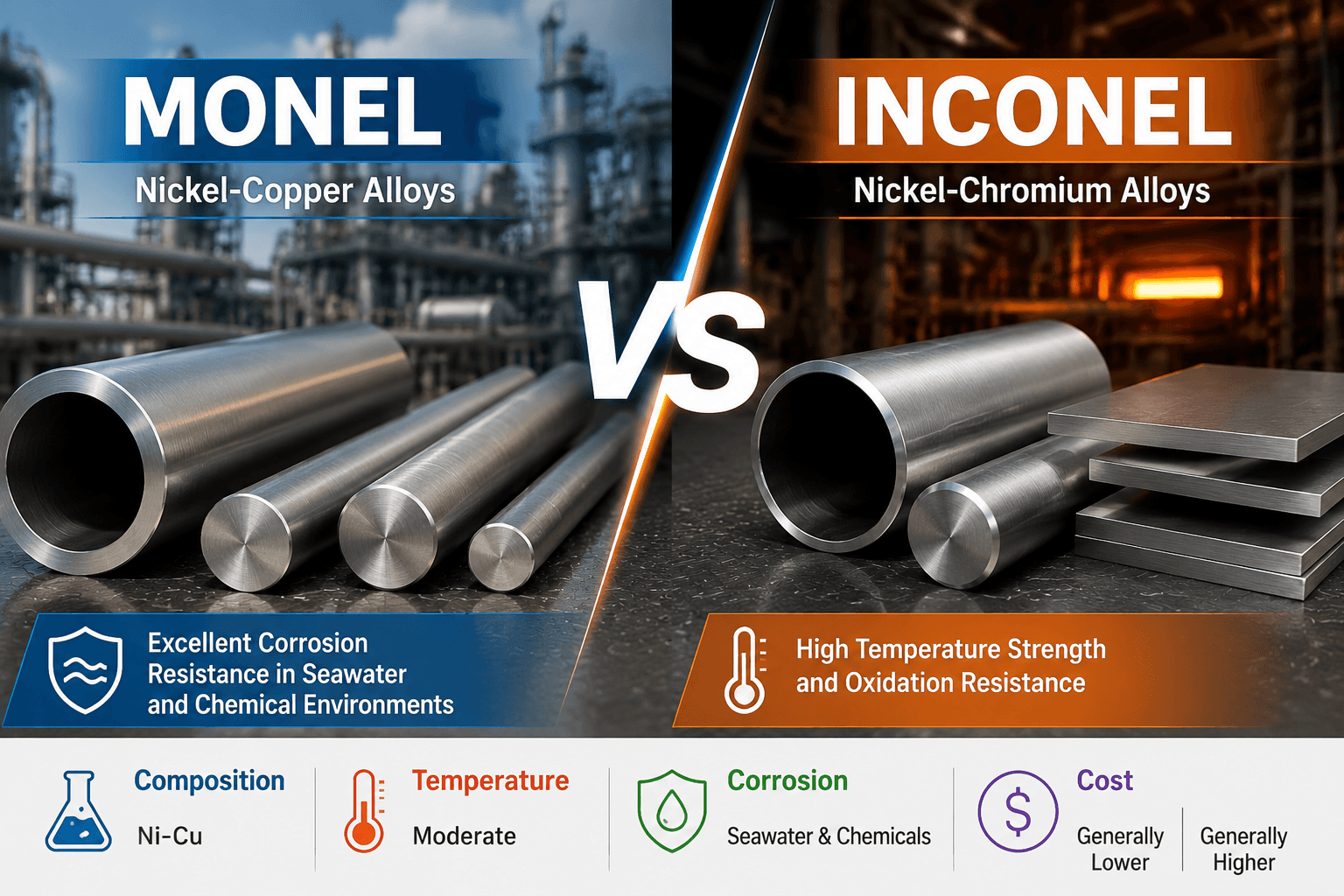
The main difference between Monel and Inconel is their alloy composition and performance focus. Monel nickel-copper alloys are mainly known for excellent seawater and chemical corrosion resistance, while Inconel nickel-chromium alloys are developed for high-temperature strength and oxidation resistance.
Selecting the correct alloy depends on operating temperature, corrosion environment, mechanical requirements and total project cost.
Quick Answer: Monel vs Inconel
- Choose Monel for seawater, marine equipment and chemical environments requiring excellent corrosion resistance.
- Choose Inconel for high-temperature applications requiring oxidation resistance and strength retention.
- Monel is usually more economical for corrosion-focused applications, while Inconel is selected when extreme temperature performance is required.
Monel Alloy Overview
Monel is a group of nickel-copper alloys containing nickel as the primary element with copper as the major alloying addition.
The most common grade is Monel 400, which provides excellent resistance to seawater, hydrofluoric acid and many chemical environments.
Monel alloys are widely used where corrosion resistance, toughness and reliability are more important than extreme temperature strength.
Main Characteristics of Monel
- Excellent seawater corrosion resistance
- Good toughness and ductility
- Good resistance to many chemical media
- Suitable for marine and chemical processing applications
Inconel Alloy Overview
Inconel is a family of nickel-chromium-based superalloys developed for high-temperature and corrosion-resistant applications.
Common grades include Inconel 600, 625 and 718. These alloys are designed to maintain mechanical strength, oxidation resistance and stability under elevated temperatures.
Compared with Monel, Inconel generally provides better performance in extreme heat environments.
Main Characteristics of Inconel
- Excellent high-temperature strength
- Superior oxidation resistance
- Good corrosion resistance in aggressive environments
- Suitable for aerospace, energy and high-temperature equipment
Monel vs Inconel Comparison Table
| Property | Monel | Inconel |
|---|---|---|
| Main Alloy System | Nickel-Copper Alloy | Nickel-Chromium Alloy |
| Primary Advantage | Corrosion resistance | High temperature performance |
| Temperature Capability | Moderate temperature applications | High temperature applications |
| Typical Environment | Marine and chemical environments | Furnaces, turbines and high-temperature systems |
| Cost Level | Generally lower | Generally higher |
Chemical Composition Difference: Monel vs Inconel
The different alloying elements determine the main performance characteristics of Monel and Inconel. Monel is based on a nickel-copper system, while Inconel is mainly based on nickel-chromium chemistry.
| Element / Feature | Monel | Inconel |
|---|---|---|
| Main Elements | Nickel + Copper | Nickel + Chromium |
| Chromium Content | Generally low or not the main alloying element | High chromium content for oxidation resistance |
| Copper Addition | Major alloying element improving corrosion resistance | Usually not the primary strengthening element |
| Strengthening Method | Solid solution strengthening or cold working | Solid solution, precipitation or age hardening depending on grade |
Because of these composition differences, Monel performs exceptionally well in seawater and reducing chemical environments, while Inconel performs better under oxidation, heat and extreme temperature conditions.
Temperature Performance: Monel vs Inconel
Temperature capability is one of the most important differences between Monel and Inconel. Inconel alloys are specifically designed for applications where mechanical strength must be maintained at elevated temperatures.
| Performance | Monel | Inconel |
|---|---|---|
| High Temperature Strength | Suitable for moderate temperature service | Maintains strength at elevated temperatures |
| Oxidation Resistance | Good in many corrosion environments | Excellent due to chromium-rich composition |
| Typical Temperature Applications | Marine and chemical processing equipment | Gas turbines, heat exchangers and furnace components |
Why Inconel Performs Better at High Temperature
Inconel alloys contain higher chromium content and are often strengthened through alloy additions such as molybdenum, niobium, aluminum or titanium depending on the grade.
These elements improve oxidation resistance, creep resistance and high-temperature mechanical stability.
For example, Inconel 625 is commonly selected for high-temperature corrosion environments, while Inconel 718 is widely used where high strength at elevated temperatures is required.
Corrosion Resistance Comparison: Monel vs Inconel
Both Monel and Inconel provide excellent corrosion resistance, but they are optimized for different corrosive environments.
| Environment | Better Choice | Reason |
|---|---|---|
| Seawater | Monel | Excellent resistance to seawater corrosion and biofouling environments |
| Hydrofluoric Acid | Monel | Nickel-copper chemistry provides excellent resistance |
| High Temperature Oxidizing Environment | Inconel | Chromium provides oxidation resistance |
| Chemical Processing | Depends on Chemical Medium | Selection depends on temperature and chemical composition |
Cost Difference Between Monel and Inconel
Material cost is an important factor when selecting nickel alloys. The final price depends on alloy grade, nickel content, alloying elements, manufacturing process and market conditions.
In general, Inconel alloys are usually more expensive than Monel because they contain higher levels of alloying elements and are designed for more demanding temperature applications.
| Factor | Impact |
|---|---|
| Alloy Composition | Higher alloy additions generally increase cost |
| Temperature Requirement | Extreme temperature service often requires higher-cost Inconel grades |
| Application Requirement | Using the correct grade avoids unnecessary material cost |
Monel vs Inconel Applications Comparison
Monel and Inconel are both high-performance nickel alloys, but their typical applications are different because of their different alloy compositions and performance advantages.
| Application | Recommended Alloy | Main Reason |
|---|---|---|
| Seawater Equipment | Monel | Excellent resistance to seawater corrosion |
| Marine Valves and Pumps | Monel | Good corrosion resistance and toughness |
| Chemical Processing Equipment | Monel / Inconel | Depends on chemical medium and operating temperature |
| Heat Exchangers | Inconel | High-temperature corrosion and oxidation resistance |
| Gas Turbine Components | Inconel | Maintains strength at elevated temperatures |
| Aerospace Components | Inconel | High strength-to-weight performance under heat |
How to Choose Between Monel and Inconel?
The correct alloy selection should be based on the actual service environment rather than material price alone. Choosing the right nickel alloy can improve service life and reduce maintenance costs.
| Requirement | Recommended Choice |
|---|---|
| Seawater corrosion resistance | Monel |
| High temperature above normal operating range | Inconel |
| Chemical corrosion at moderate temperature | Monel or specific Inconel grade depending on medium |
| Oxidation resistance | Inconel |
| Lower material cost with good corrosion resistance | Monel |
Common ASTM Standards for Monel and Inconel
Nickel alloy products are supplied according to different ASTM specifications depending on product form, grade and application requirements.
| Standard | Product Form | Typical Alloy |
|---|---|---|
| ASTM B164 | Nickel-copper alloy rods, bars and wire | Monel 400 |
| ASTM B865 | Nickel-copper alloy bars and forgings | Monel K500 |
| ASTM B446 | Nickel-chromium-molybdenum alloy bars | Inconel 625 |
| ASTM B637 | Nickel alloy bars and forgings | Inconel 718 |
FAQ
What is the main difference between Monel and Inconel?
Monel is a nickel-copper alloy mainly designed for corrosion resistance, especially in marine environments. Inconel is a nickel-chromium alloy designed for high-temperature strength and oxidation resistance.
Is Inconel stronger than Monel?
Many Inconel grades provide higher high-temperature strength than common Monel grades. However, the best choice depends on the application requirements, temperature and environment.
Which is better for seawater, Monel or Inconel?
Monel is commonly selected for seawater applications because its nickel-copper composition provides excellent resistance to seawater corrosion.
Why is Inconel more expensive than Monel?
Inconel is usually more expensive because many grades contain higher alloy additions and are designed for more demanding high-temperature applications.
Can Monel and Inconel be customized?
Yes. Both alloy families can be supplied in bars, plates, sheets, pipes, tubes and wires with customized dimensions and inspection requirements.
Monel and Inconel Supply from SASA ALLOY
SASA ALLOY supplies nickel alloy materials including Monel and Inconel products for marine, chemical, energy and high-temperature applications.
Available products include:
- Monel 400 / K500 Round Bar
- Inconel 600 / 625 / 718 Round Bar
- Nickel Alloy Plate and Sheet
- Nickel Alloy Pipe and Tube
- Nickel Alloy Wire and Welding Materials
Products can be supplied with material certificates, inspection reports and customized processing according to customer requirements.
For quotation requests, please provide alloy grade, product form, dimensions, quantity and service environment.
Conclusion
Monel and Inconel are both excellent nickel-based alloys, but they solve different engineering problems. Monel is generally preferred when corrosion resistance and cost efficiency are the main concerns, while Inconel is selected for extreme temperature, oxidation and high-strength applications.
Understanding alloy composition, temperature capability, corrosion performance and application requirements helps engineers choose the most suitable nickel alloy for long-term performance.
Post time: Jul-29-2026