Introduction
Monel 400 and Monel K500 are two important nickel-copper alloys widely used in marine, chemical processing and industrial applications. Although both alloys provide excellent corrosion resistance, their mechanical properties and strengthening methods are significantly different.
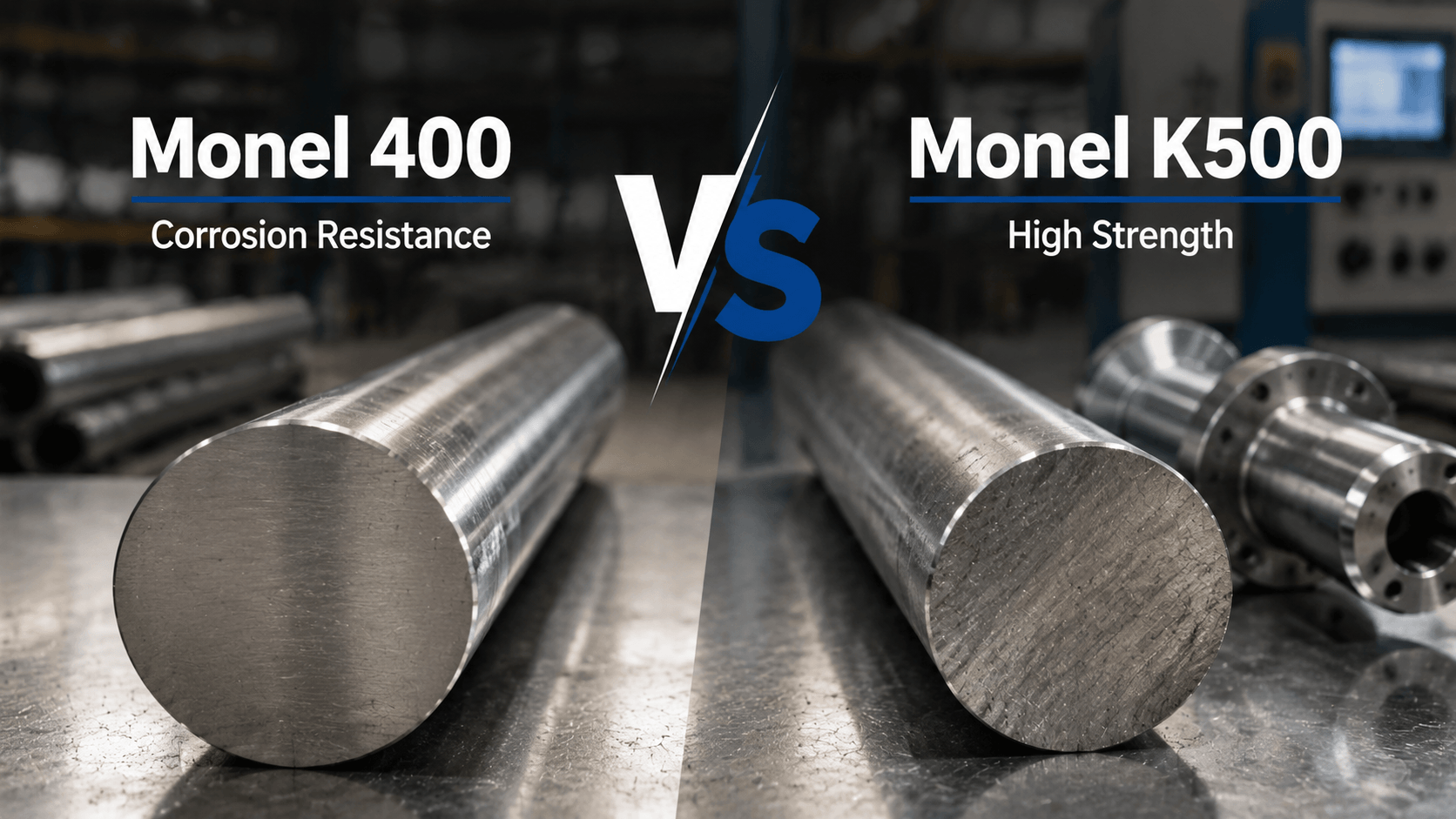
The main difference between Monel 400 and K500 is that Monel 400 focuses on corrosion resistance and toughness, while Monel K500 provides higher strength and hardness through precipitation hardening.
Understanding the differences in strength, heat treatment, corrosion resistance and applications helps engineers select the appropriate Monel grade for each project.
Quick Answer: Monel 400 vs Monel K500
- Choose Monel 400 when corrosion resistance, toughness and general marine performance are the main requirements.
- Choose Monel K500 when higher strength, hardness and wear resistance are required.
- Both alloys provide excellent resistance to seawater and many chemical environments, but K500 offers superior mechanical performance.
Monel 400 Overview
Monel 400 is a nickel-copper alloy containing approximately two-thirds nickel and one-third copper. It is one of the most widely used Monel grades because of its excellent corrosion resistance and good mechanical properties.
Monel 400 maintains reliable performance in seawater, hydrofluoric acid and many chemical environments. It also provides excellent toughness over a wide temperature range.
Main Characteristics of Monel 400
- Excellent seawater corrosion resistance
- Good toughness and ductility
- Good weldability and fabrication performance
- Suitable for marine and chemical applications
Monel K500 Overview
Monel K500 is a nickel-copper alloy developed from Monel 400 with additional aluminum and titanium. These elements allow the alloy to achieve higher strength through precipitation hardening heat treatment.
Compared with Monel 400, Monel K500 provides significantly improved tensile strength, yield strength and hardness while maintaining excellent corrosion resistance.
Main Characteristics of Monel K500
- Higher strength than Monel 400
- Precipitation hardening capability
- Improved wear resistance
- Suitable for mechanical components under high loads
Monel 400 vs K500 Comparison Table
The following table summarizes the major differences between Monel 400 and Monel K500.
| Property | Monel 400 | Monel K500 |
|---|---|---|
| Alloy Type | Nickel-copper alloy | Precipitation hardenable nickel-copper alloy |
| Main Advantage | Excellent corrosion resistance | High strength and hardness |
| Strength Level | Medium strength | Higher mechanical strength |
| Hardening Method | Cold working | Precipitation hardening |
| Aluminum / Titanium Addition | No | Yes |
| Corrosion Resistance | Excellent | Excellent |
| Typical Applications | Marine equipment, chemical processing | Shafts, fasteners, springs and high-load components |
Monel 400 vs Monel K500: Strength Comparison
The biggest difference between Monel 400 and Monel K500 is mechanical strength. While both alloys have excellent corrosion resistance, Monel K500 is specifically developed to provide higher strength through precipitation hardening.
Monel 400 provides a good balance of strength, toughness and corrosion resistance, making it suitable for general industrial applications. Monel K500 offers significantly higher yield strength and hardness, making it suitable for components exposed to heavy mechanical loads.
| Mechanical Property | Monel 400 | Monel K500 |
|---|---|---|
| Tensile Strength | Good mechanical strength for corrosion-resistant applications | Higher tensile strength for demanding mechanical applications |
| Yield Strength | Moderate | Significantly higher after aging treatment |
| Hardness | Lower hardness with excellent toughness | Higher hardness and improved wear resistance |
| Ductility | Excellent ductility and fabrication performance | Lower ductility due to strengthening treatment |
Hardening Mechanism: Monel 400 vs K500
The different strengthening mechanisms are the main reason why Monel K500 achieves higher mechanical performance than Monel 400.
Monel 400 Hardening
Monel 400 is a solid-solution nickel-copper alloy. Its strength can be increased through cold working, but it does not use precipitation hardening.
- Good toughness
- Excellent formability
- Suitable for welding and fabrication
Monel K500 Hardening
Monel K500 contains aluminum and titanium additions. After solution treatment and aging treatment, these elements form strengthening phases that significantly increase strength and hardness.
Typical Monel K500 Heat Treatment Process:
Solution Treatment → Aging Treatment → Higher Strength and Hardness
This precipitation hardening capability allows Monel K500 to maintain corrosion resistance while providing improved mechanical performance.
Monel 400 vs K500 Corrosion Resistance
Both Monel 400 and Monel K500 provide excellent corrosion resistance because of their high nickel and copper content. In many corrosive environments, the difference between the two grades is not corrosion resistance itself, but mechanical performance requirements.
| Environment | Recommended Grade | Reason |
|---|---|---|
| Seawater Equipment | Monel 400 | Excellent corrosion resistance and toughness |
| Marine Shafts and Mechanical Parts | Monel K500 | Requires corrosion resistance plus higher strength |
| Chemical Processing | Monel 400 | Excellent resistance in many chemical environments |
| High Load Marine Components | Monel K500 | Higher mechanical strength and wear resistance |
Machining and Fabrication Differences
The difference in strength between Monel 400 and Monel K500 also affects machining and fabrication processes.
| Process | Monel 400 | Monel K500 |
|---|---|---|
| Machining | Generally easier due to lower hardness | Requires controlled machining due to higher hardness |
| Welding | Good welding performance | Requires proper heat treatment considerations |
| Forming | Excellent forming capability | More difficult due to higher strength |
Monel 400 vs K500 Applications Comparison
Although Monel 400 and Monel K500 have similar corrosion resistance, their different mechanical properties make them suitable for different applications.
| Application | Recommended Grade | Reason |
|---|---|---|
| Seawater Piping and Valves | Monel 400 | Excellent seawater corrosion resistance and good fabrication performance |
| Marine Shafts | Monel K500 | Higher strength and wear resistance under mechanical loads |
| Chemical Processing Equipment | Monel 400 | Reliable corrosion resistance in chemical environments |
| Pump Components | Monel K500 | Higher mechanical strength and fatigue resistance |
| Fasteners and Springs | Monel K500 | High strength and hardness requirements |
How to Choose Between Monel 400 and K500?
The selection between Monel 400 and Monel K500 should be based on the actual service conditions, mechanical requirements and fabrication needs.
| Requirement | Recommended Material |
|---|---|
| Maximum corrosion resistance and toughness | Monel 400 |
| High mechanical strength | Monel K500 |
| Easy fabrication and welding | Monel 400 |
| Wear resistance and high-load components | Monel K500 |
| Standard marine corrosion applications | Monel 400 |
Monel 400 and K500 Standards
Monel products are supplied according to different ASTM standards depending on product form, grade and application requirements.
| Standard | Product Form | Grade |
|---|---|---|
| ASTM B164 | Nickel-copper alloy rods, bars and wire | Monel 400 |
| ASTM B127 | Plate, sheet and strip | Monel 400 |
| ASTM B865 | Bars and forgings | Monel K500 |
FAQ
What is the difference between Monel 400 and Monel K500?
Monel 400 is mainly selected for corrosion resistance and toughness, while Monel K500 is strengthened through precipitation hardening to provide higher strength and hardness.
Is Monel K500 stronger than Monel 400?
Yes. Monel K500 provides significantly higher strength and hardness because of aluminum and titanium additions combined with aging heat treatment.
Which is better for seawater, Monel 400 or K500?
Both alloys perform well in seawater. Monel 400 is commonly selected for corrosion-focused applications, while Monel K500 is preferred when seawater exposure is combined with mechanical loading.
Why is Monel K500 heat treated?
Monel K500 uses precipitation hardening heat treatment to increase strength, hardness and wear resistance while maintaining corrosion resistance.
Can Monel 400 and K500 be customized?
Yes. Monel 400 and K500 products can be supplied in different forms including bars, plates, sheets, pipes, tubes and wires according to project requirements.
Monel 400 and K500 Supply from SASA ALLOY
SASA ALLOY supplies Monel 400 and Monel K500 materials for marine, chemical processing and industrial applications.
Available product forms include:
- Monel 400 Round Bar
- Monel K500 Round Bar
- Monel Plate and Sheet
- Monel Pipe and Tube
- Monel Wire
Materials can be supplied with customized dimensions, material certificates and inspection documents according to customer requirements.
For quotation requests, please provide alloy grade, product form, dimensions, quantity and application information.
Conclusion
Monel 400 and Monel K500 are both high-performance nickel-copper alloys with excellent corrosion resistance. The key difference is that Monel 400 focuses on corrosion resistance and fabrication flexibility, while Monel K500 provides enhanced strength through precipitation hardening.
For corrosion-dominated environments, Monel 400 is often the preferred choice. For components requiring higher mechanical strength, hardness and wear resistance, Monel K500 provides better performance.
Post time: Jul-29-2026