Introduction
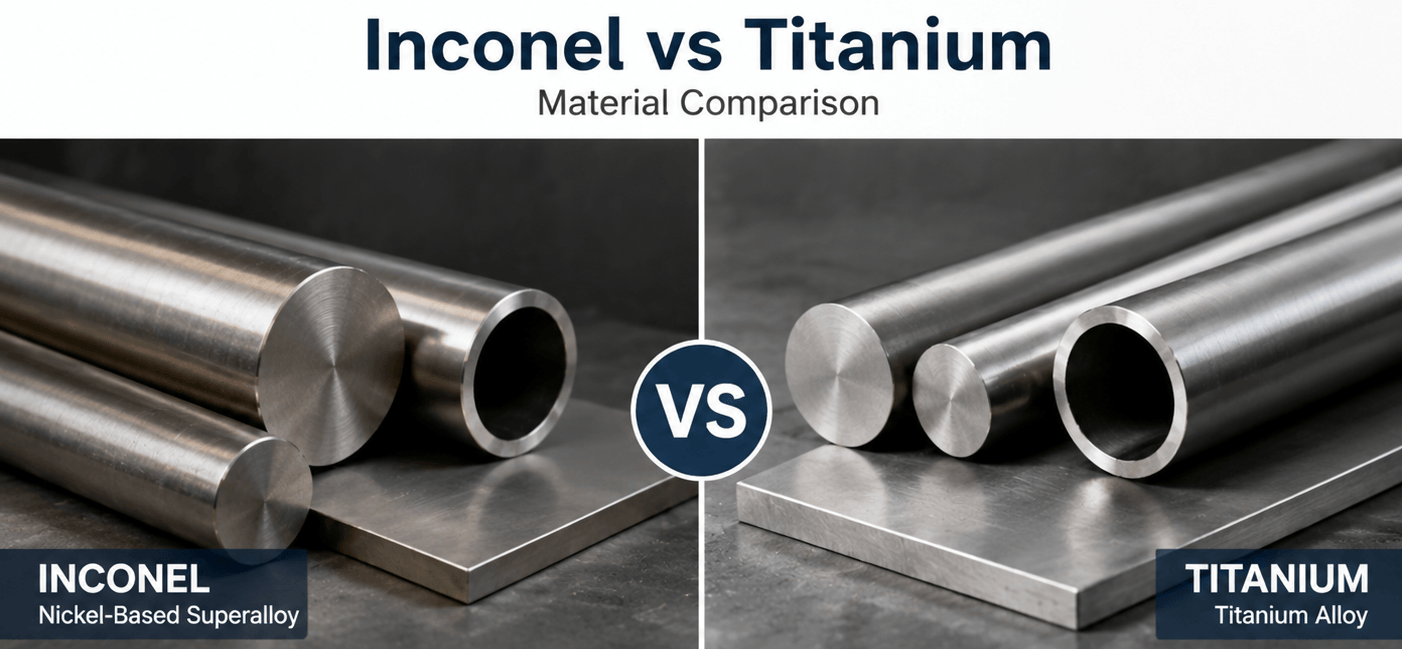
Inconel and titanium are two high-performance materials widely used in aerospace, chemical processing, energy and industrial applications. Although both provide excellent strength-to-weight ratios and corrosion resistance, their advantages are different.
Inconel is a family of nickel-based superalloys designed for extreme temperature environments, while titanium alloys are known for their lightweight properties, high strength and excellent corrosion resistance.
The choice between Inconel and titanium depends on operating temperature, mechanical requirements, weight limitations, corrosion environment and project budget.
Quick Answer: Inconel vs Titanium, Which Is Better?
- Inconel performs better in extreme high-temperature applications such as turbine engines and heat-resistant components.
- Titanium provides a much higher strength-to-weight ratio and is preferred for lightweight aerospace structures.
- Inconel generally costs more because of its high nickel and alloying element content.
- The correct choice depends on whether temperature performance or weight reduction is the priority.
What Is Inconel?
Inconel is a group of nickel-chromium-based superalloys developed for applications requiring high strength, oxidation resistance and corrosion resistance at elevated temperatures.
Common Inconel grades include Inconel 600, 601, 625 and 718. Different grades are designed for specific environments such as heat treatment equipment, aerospace engines, chemical processing and marine systems.
Characteristics of Inconel Alloys
- Excellent high-temperature mechanical strength.
- Outstanding oxidation and corrosion resistance.
- Good performance under thermal cycling conditions.
- Suitable for extreme operating environments.
What Is Titanium?
Titanium is a lightweight metal with an excellent strength-to-weight ratio, high corrosion resistance and good biocompatibility.
Common titanium grades include commercially pure Titanium Grade 2 and titanium alloy Grade 5 (Ti-6Al-4V). These materials are widely used in aerospace structures, medical implants, marine equipment and chemical applications.
Characteristics of Titanium Alloys
- Low density compared with nickel-based alloys.
- Excellent corrosion resistance.
- High strength-to-weight ratio.
- Good performance in aerospace and lightweight structures.
Inconel vs Titanium: Material Comparison Overview
| Property | Inconel | Titanium |
|---|---|---|
| Material Type | Nickel-based superalloy | Titanium and titanium alloy |
| Main Advantage | High-temperature performance | Lightweight strength |
| Density | Higher | Lower |
| Temperature Capability | Excellent at elevated temperatures | Limited compared with nickel alloys |
Inconel vs Titanium Strength Comparison
Both Inconel and titanium alloys provide high mechanical performance, but their strength advantages appear in different operating conditions.
Titanium is valued for its excellent strength-to-weight ratio, while Inconel maintains high strength even at elevated temperatures where many lightweight alloys lose performance.
| Property | Inconel 718 | Titanium Grade 5 (Ti-6Al-4V) |
|---|---|---|
| Tensile Strength | High strength, especially after heat treatment | High strength with lower density |
| High Temperature Strength | Excellent retention at elevated temperatures | Strength decreases at higher temperatures |
| Strength-to-Weight Ratio | Good | Excellent |
Which Is Stronger: Inconel or Titanium?
The answer depends on the application conditions. Titanium alloys often provide a better strength-to-weight ratio, making them ideal for lightweight structures.
Inconel alloys generally provide better strength retention under extreme temperatures and mechanical stress, making them suitable for turbine engines, combustion components and heat-resistant equipment.
Temperature Resistance Comparison
Temperature capability is one of the biggest differences between Inconel and titanium. Nickel-based superalloys such as Inconel are specifically developed for high-temperature environments.
| Material | Typical Temperature Capability | Common Applications |
|---|---|---|
| Inconel 600 | High-temperature oxidation and corrosion environments | Furnace equipment, chemical processing |
| Inconel 718 | High strength at elevated temperatures | Aerospace engines, turbines |
| Titanium Grade 5 | Suitable for moderate temperature aerospace applications | Aircraft structures, medical components |
Titanium is generally limited in high-temperature applications because it loses mechanical strength and may react with oxygen at elevated temperatures. Inconel remains stable in environments where heat resistance is the primary requirement.
Weight Comparison: Inconel vs Titanium
Weight is a major factor in aerospace and transportation industries. Titanium has a significant advantage because its density is much lower than nickel-based superalloys.
| Material | Approximate Density | Weight Advantage |
|---|---|---|
| Titanium Alloy | About 4.5 g/cm³ | Excellent lightweight performance |
| Inconel Alloy | About 8.0–8.5 g/cm³ | Higher weight but better temperature capability |
For applications where reducing weight is the main goal, titanium is often preferred. For components exposed to extreme heat, the additional weight of Inconel is usually acceptable because of its superior temperature performance.
Cost Comparison: Inconel vs Titanium
Both Inconel and titanium are premium engineering materials, but their costs are influenced by alloy composition, processing difficulty and market demand.
| Cost Factor | Inconel | Titanium |
|---|---|---|
| Raw Material Cost | Usually higher due to nickel and alloying elements | High but generally lower than many nickel superalloys |
| Machining Cost | High due to work hardening and tool wear | Requires specialized machining methods |
| Long-Term Value | Excellent in extreme environments | Excellent when weight reduction is important |
Applications Comparison: Inconel vs Titanium
Inconel and titanium serve different roles in advanced engineering applications. The material selection depends mainly on operating temperature, weight requirements, corrosion environment and mechanical performance.
| Industry | Preferred Material | Reason |
|---|---|---|
| Aerospace Structures | Titanium | Low density and excellent strength-to-weight ratio |
| Jet Engine Components | Inconel | Maintains strength under extreme temperatures |
| Chemical Processing | Inconel / Titanium | Selection depends on chemical medium and temperature |
| Medical Applications | Titanium | Excellent biocompatibility and lightweight properties |
| Heat Treatment Equipment | Inconel | High oxidation and thermal resistance |
How to Choose Between Inconel and Titanium
Choosing between Inconel and titanium requires evaluating the actual service conditions rather than comparing only material strength or price.
| Requirement | Recommended Material |
|---|---|
| Extreme temperature resistance | Inconel |
| Weight reduction | Titanium |
| High-temperature oxidation resistance | Inconel |
| High strength-to-weight ratio | Titanium |
| Marine corrosion resistance | Titanium or selected Inconel grades |
Inconel and Titanium Standards
Inconel and titanium materials are commonly supplied according to international standards that define chemical composition, mechanical properties and product requirements.
| Material | Common Standards |
|---|---|
| Inconel 600 | ASTM B166 (Bar, Rod), ASTM B167 (Pipe and Tube) |
| Inconel 625 | ASTM B446 (Bar), ASTM B443 (Plate and Sheet) |
| Inconel 718 | AMS specifications for aerospace applications |
| Titanium Grade 2 / Grade 5 | ASTM B265, ASTM B348 |
FAQ
Is Inconel stronger than titanium?
Inconel generally provides better strength retention at high temperatures, while titanium provides a superior strength-to-weight ratio. The better choice depends on operating conditions.
Which is better for aerospace applications, Inconel or titanium?
Titanium is commonly used for aircraft structures because of its lightweight properties. Inconel is preferred for engine components exposed to high temperatures.
Why is Inconel more expensive than titanium?
Inconel often has a higher cost due to its nickel content, alloying elements and complex manufacturing requirements. Titanium also has high production costs due to processing difficulty.
Can titanium replace Inconel in high-temperature applications?
Usually not. Titanium has excellent properties but is generally limited at temperatures where Inconel maintains mechanical strength and oxidation resistance.
Which material has better corrosion resistance?
Both materials have excellent corrosion resistance. Titanium performs exceptionally well in seawater and many chemical environments, while specific Inconel grades provide excellent resistance in high-temperature and aggressive chemical conditions.
Nickel Alloy and Titanium Solutions from SASA ALLOY
SASA ALLOY supplies nickel-based superalloys including Inconel materials and titanium alloys for aerospace, energy, chemical and industrial applications.
Available products include Inconel bars, plates, pipes, tubes and titanium materials with customized dimensions and material documentation.
Technical support is available for material selection according to temperature requirements, corrosion environment, mechanical performance and application conditions.
For alloy requirements, please provide material grade, product form, dimensions, quantity and service environment.
Conclusion
Inconel and titanium are both advanced engineering materials, but they solve different engineering challenges.
Titanium is the preferred choice when lightweight performance and high strength-to-weight ratio are important. Inconel is the better solution when components must maintain strength and corrosion resistance under extreme temperatures.
Understanding the differences between Inconel and titanium helps engineers select the most suitable alloy for aerospace, chemical, energy and industrial applications.
Post time: Jul-25-2026