Nickel-based superalloys are essential in aerospace systems where components must withstand heat, pressure, vibration, fatigue and corrosive media. Inconel 718 and Inconel 625 are two widely specified grades, but they solve different engineering problems. In most cases, Alloy 718 is selected for higher age-hardened strength, while Alloy 625 is selected for corrosion resistance, weldability and fabrication flexibility.
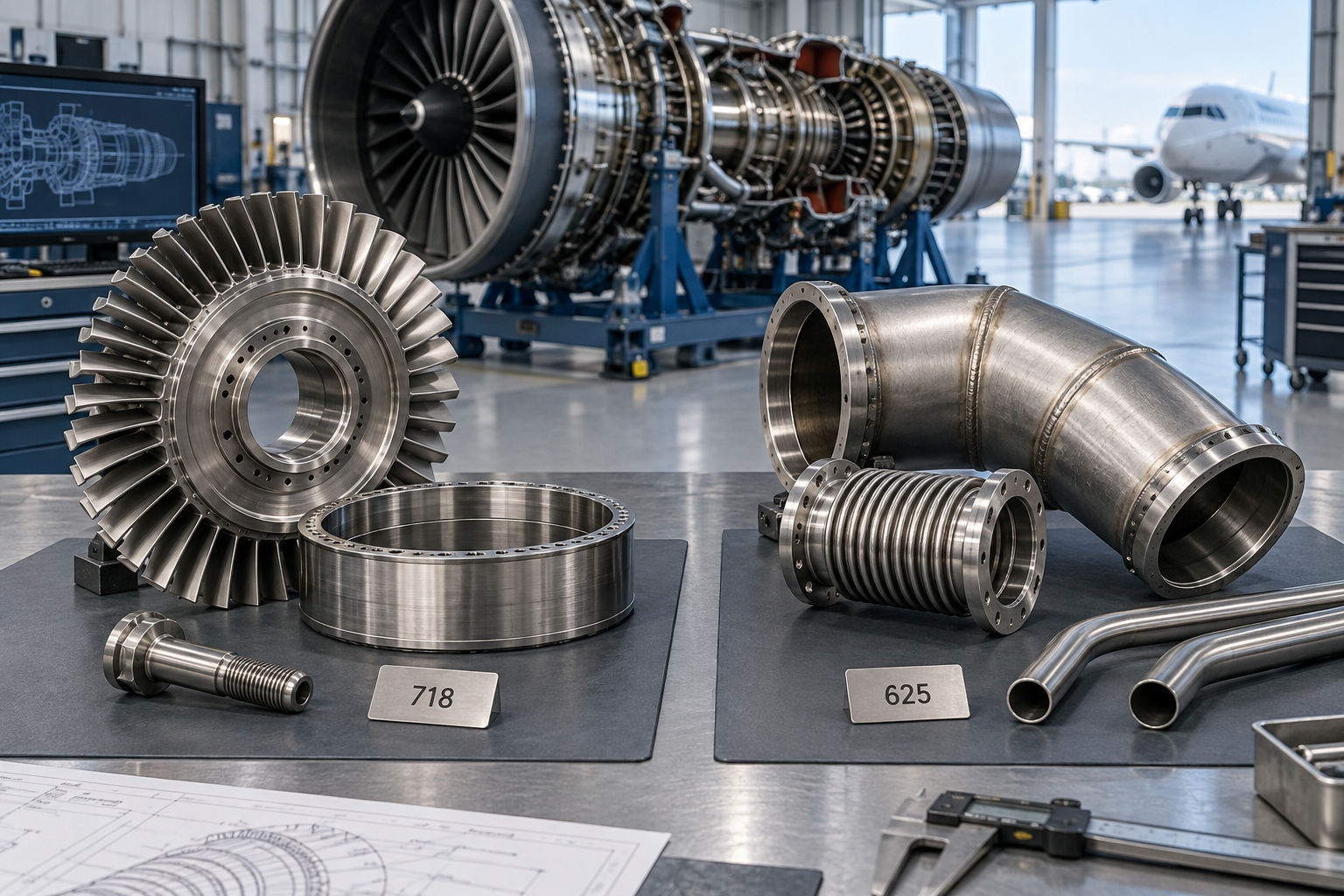
Quick Answer: Inconel 718 or Inconel 625?
Choose Inconel 718 when the component requires high tensile and yield strength, fatigue resistance, creep performance and reliable load-bearing capability at elevated temperature.
Choose Inconel 625 when corrosion resistance, oxidation resistance, weldability, formability and manufacturing of sheet, tube, ducting or bellows are the primary requirements.
The final selection must consider temperature together with applied stress, exposure time, corrosive environment, product form, joining method and the governing aerospace specification.
Inconel 718 vs. Inconel 625 at a Glance
| Selection factor | Inconel 718 | Inconel 625 |
|---|---|---|
| UNS designation | N07718 | N06625 |
| European designation | 2.4668 | 2.4856 |
| Strengthening mechanism | Precipitation hardening | Primarily solid-solution strengthening |
| Mechanical strength | Higher after aging | Moderate to high |
| Corrosion resistance | Very good | Generally better in aggressive aqueous environments |
| Weldability | Good, with heat-treatment control | Excellent for fabricated assemblies |
| Typical aerospace role | Highly loaded engine and structural components | Corrosion-resistant and welded components |
| Main advantage | High load-bearing strength | Corrosion resistance and fabrication flexibility |
What Is Inconel 718?
Inconel 718, or UNS N07718, is a precipitation-hardenable nickel-chromium alloy. Niobium, titanium and aluminum support the formation of strengthening precipitates during controlled solution treatment and aging. This gives the alloy high tensile, fatigue, creep and stress-rupture properties.
Alloy 718 is used from cryogenic conditions to approximately 1300°F (704°C), depending on stress, exposure time, product form and specification. It is widely considered for aircraft and rocket components that must carry substantial mechanical loads.
Typical aerospace applications for Alloy 718
- Gas-turbine disks and rings
- Compressor and engine cases
- High-strength shafts and fasteners
- Rocket-engine components
- Cryogenic tanks and instrumentation
- Springs and retaining components
- High-load structural hardware
What Is Inconel 625?
Inconel 625, or UNS N06625, is a nickel-chromium-molybdenum-niobium alloy. It is strengthened mainly by solid-solution effects and normally does not require the precipitation-aging cycle used for Alloy 718.
The alloy's molybdenum and niobium content contributes to useful strength and strong resistance to pitting and crevice corrosion. Its balance of corrosion resistance, oxidation resistance and weldability makes it attractive for fabricated aerospace systems.
Typical aerospace applications for Alloy 625
- Aircraft exhaust systems
- Flexible bellows and expansion joints
- Engine ducting and heat shields
- Welded tubing
- Fuel and hydraulic system components
- Parts exposed to chloride-containing media
- Corrosion-resistant overlays and repairs
1. Mechanical Strength and Load-Bearing Performance
Mechanical strength is one of the clearest differences between the alloys. After the specified aging treatment, Alloy 718 generally provides substantially higher tensile and yield strength than annealed Alloy 625. This makes Alloy 718 the usual starting point for turbine disks, rotating hardware, engine cases and high-strength fasteners.
Alloy 625 still provides useful strength, but it is more often selected when moderate loading is combined with severe corrosion, thermal cycling or extensive welding. Designers should compare certified properties in the actual product form and heat-treatment condition rather than relying on nominal grade descriptions.
2. Temperature Capability
A published maximum temperature does not by itself identify the better aerospace alloy. Oxidation resistance, short-term tensile strength, long-term creep strength and stress-rupture behavior are different design criteria.
- Maximum and continuous operating temperature
- Mechanical stress at temperature
- Required creep and stress-rupture life
- Frequency of thermal cycling
- Oxidizing or corrosive atmosphere
- Required component life and inspection interval
For mechanically loaded hardware operating within the qualified range, heat-treated Alloy 718 is frequently evaluated first. For ducts, shields and bellows where oxidation resistance and fabrication matter more than maximum yield strength, Alloy 625 may be more suitable.
3. Corrosion and Oxidation Resistance
Both alloys resist oxidation and many corrosive environments. Alloy 625 generally has the advantage in aggressive aqueous conditions because its nickel-chromium-molybdenum chemistry provides strong resistance to pitting, crevice corrosion, chloride-containing media, seawater and many chemical solutions.
Alloy 718 also provides good environmental resistance, but its primary engineering value is the combination of corrosion resistance and high age-hardened strength. If corrosion is the dominant failure mode, Alloy 625 should receive close consideration. If high mechanical loading is dominant, Alloy 718 may offer the better property balance.
4. Welding and Fabrication
Alloy 625 is generally the more straightforward option for complicated welded structures. It offers good ductility in the annealed condition and does not depend on a precipitation-aging treatment to develop its normal service properties. These characteristics support the manufacture of tubing, sheet-metal assemblies, exhaust ducts, bellows and expansion joints.
Alloy 718 also has favorable welding characteristics compared with many high-strength nickel superalloys. However, welding sequence, heat input, the heat-affected zone and subsequent heat treatment must be controlled so that the finished component develops the specified properties.
5. Heat Treatment Requirements
Alloy 718 heat treatment
Alloy 718 normally requires a specified solution treatment and aging cycle. Aerospace specifications may require different cycles according to product form and application. Temperature, holding time and cooling practice can affect precipitate formation, grain structure, strength, fatigue life and dimensional stability.
Alloy 625 heat treatment
Alloy 625 is generally supplied in an annealed condition and normally does not require the same two-stage aging treatment. This can simplify production of formed and welded components. Thermal exposure can still change its microstructure and properties, so the ordered condition must match the operating requirement.
6. Machining Considerations
Both alloys work-harden rapidly. Alloy 718 becomes particularly demanding after aging because of its high strength. Alloy 625 also requires rigid equipment and controlled cutting practices, although machining in the annealed condition may be less demanding for some operations.
- Avoid tool dwell and rubbing
- Maintain positive and consistent feed
- Use rigid workholding
- Control cutting temperature
- Select tooling designed for nickel alloys
- Allow for possible heat-treatment distortion
Aerospace Component Selection Guide
| Aerospace component | Common starting choice | Main reason |
|---|---|---|
| Turbine disk or ring | Alloy 718 | High age-hardened strength and fatigue resistance |
| Engine casing | Alloy 718 | Strength and dimensional stability |
| High-strength fastener | Alloy 718 | High tensile and yield strength |
| Rocket structural component | Alloy 718 | Strength across cryogenic and elevated temperatures |
| Exhaust duct | Alloy 625 | Oxidation resistance and weldability |
| Flexible bellows | Alloy 625 | Formability, corrosion resistance and fatigue capability |
| Expansion joint | Alloy 625 | Fabrication flexibility and thermal-cycle resistance |
| Corrosion-resistant tubing | Alloy 625 | Resistance to aggressive fluids |
| Highly welded assembly | Alloy 625 | Good welding performance and simpler processing |
Common Specifications
A material designation alone does not define the required product. Procurement documents should specify the applicable revision, product form, dimensions, condition, testing and certification.
Common Alloy 718 specifications
- AMS 5596 for sheet, strip and plate
- AMS 5662 and AMS 5663 for bars, forgings and rings in specified conditions
- ASTM B637 for bars, forgings and forging stock
- UNS N07718
Common Alloy 625 specifications
- AMS 5599 for sheet, strip and plate
- AMS 5666 for bars, forgings and rings
- AMS 5581 for tubing
- ASTM B443 for plate, sheet and strip
- ASTM B444 for seamless pipe and tube
- ASTM B446 for rod and bar
- UNS N06625
Five Questions to Ask Before Selecting the Alloy
- What are the continuous and maximum operating temperatures?
- How much mechanical load must the component carry at temperature?
- Will it encounter chlorides, seawater, combustion products or aggressive chemicals?
- Will the component be forged, machined, formed or extensively welded?
- Which AMS, ASTM, ASME or customer specification controls acceptance?
Conclusion
Inconel 718 and Inconel 625 address different aerospace engineering priorities. Alloy 718 is generally the better candidate for highly loaded components requiring strength, fatigue resistance and controlled high-temperature mechanical performance. Alloy 625 is generally the better candidate for corrosion-resistant tubing, exhaust systems, bellows, ducts and welded assemblies.
The correct choice should be based on temperature, applied stress, environment, manufacturing route, heat-treatment condition and the governing specification. Certified material test reports and application-specific design requirements should be reviewed before either alloy is approved.
Frequently Asked Questions
Is Inconel 718 stronger than Inconel 625?
In its properly aged condition, Alloy 718 generally provides higher tensile and yield strength than annealed Alloy 625. This is why it is frequently specified for turbine components, fasteners and highly loaded aerospace hardware.
Is Inconel 625 more corrosion resistant than Inconel 718?
Alloy 625 generally offers better resistance to aggressive aqueous corrosion, particularly pitting and crevice corrosion in chloride-containing environments.
Which alloy is easier to weld?
Alloy 625 is generally preferred for complex welded assemblies because it combines good welding characteristics with simpler post-weld processing. Alloy 718 is weldable, but its heat-treatment route must be carefully controlled.
Which alloy is better for aircraft exhaust systems?
Alloy 625 is commonly evaluated for exhaust ducts, bellows and related fabricated components because it combines oxidation resistance, formability and weldability.
Which alloy is better for turbine components?
Alloy 718 is commonly selected for turbine disks, rings, cases and other mechanically loaded parts because of its age-hardened strength and fatigue performance.
Can Inconel 625 replace Inconel 718?
Not automatically. Alloy 625 may not provide the mechanical strength required for a component designed around aged Alloy 718. Any substitution requires an engineering review.
Can Inconel 718 replace Inconel 625?
Not automatically. Higher strength does not guarantee equal corrosion resistance, fabrication behavior or welding performance. The service environment and manufacturing route must be reviewed before substitution.
Discuss Your Aerospace Alloy Requirements
Send us the required alloy, product form, dimensions, specification, quantity and delivery destination. Include operating temperature, load conditions and any inspection or certification requirements so the quotation scope can be reviewed accurately.
Post time: Sep-11-2026