Quick answer: Neither alloy is universally better. Inconel 625 is often the practical choice when a component needs a strong combination of seawater resistance, strength and fabrication flexibility. Hastelloy C276 is usually the stronger candidate for severe chemical service involving higher concentrations of reducing acids, mixed contaminants or aggressive chloride-bearing media. Final selection must be based on the actual chemical concentration, temperature, pressure, impurities, aeration, flow, crevices, weld condition and product standard.
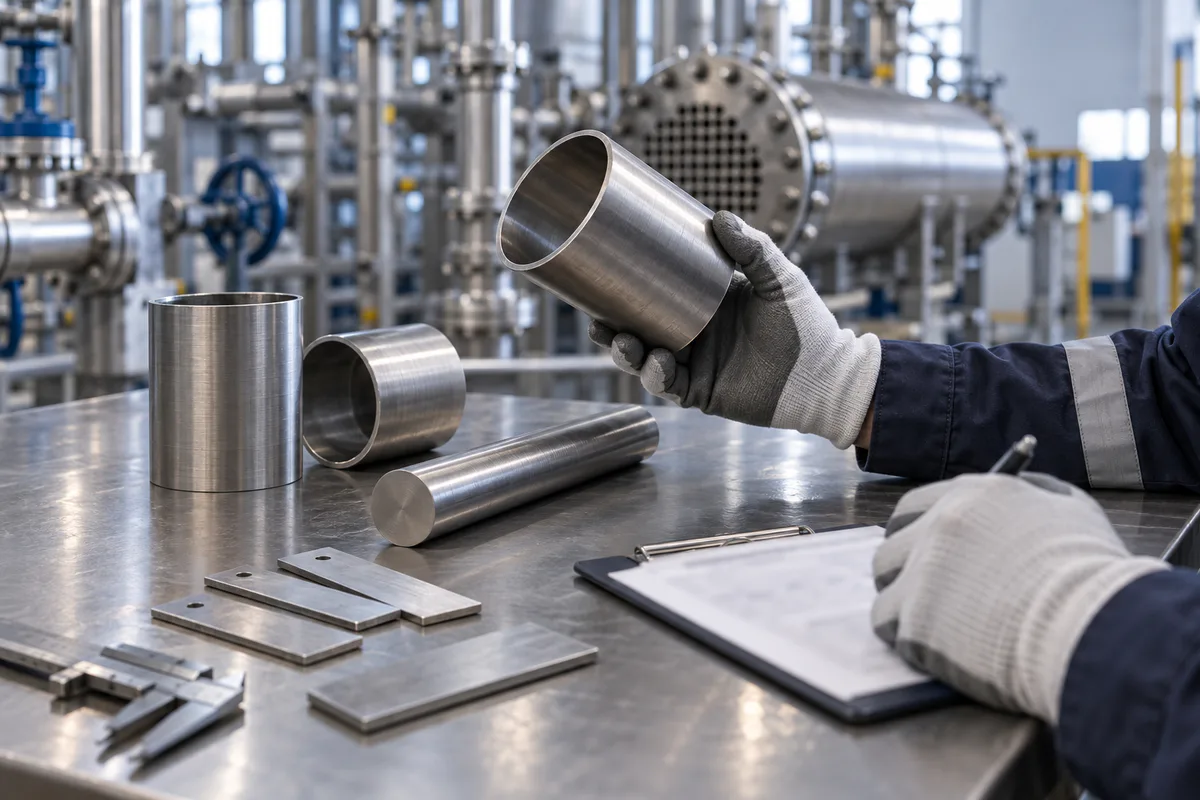
The most useful comparison is not a single “corrosion resistance” ranking. A buyer needs to know which degradation mechanism controls the design, whether strength or wall thickness matters, and what evidence must appear on the material certificate. This guide turns the Alloy 625 versus C276 question into a service-condition decision.
The difference that drives the selection
Both are nickel-chromium-molybdenum alloys, but their alloying balance is different. Alloy 625 uses niobium with molybdenum to strengthen the nickel-chromium matrix. C276 contains substantially more molybdenum and includes tungsten, while maintaining very low carbon and silicon limits. Those differences help explain why the alloys overlap in many environments but are not interchangeable.
| Selection factor | Inconel 625 / UNS N06625 | Hastelloy C276 / UNS N10276 |
|---|---|---|
| Design emphasis | Strength plus broad corrosion resistance | Maximum versatility in severe chemical corrosion |
| Key alloying distinction | Molybdenum and niobium strengthen the matrix | Higher molybdenum with tungsten; very low carbon and silicon |
| Common decision driver | Seawater, offshore hardware, pressure components and corrosion-fatigue demands | Hydrochloric or sulfuric acid severity, mixed process streams, contaminated media and localized attack |
| Procurement caution | Product form and supplied condition affect the governing specification and properties | Laboratory corrosion charts do not replace testing in the actual process solution |
Engineering note: The comparison above describes general selection tendencies, not guaranteed performance. A change in acid concentration, temperature, dissolved oxygen, chloride level, contaminants or shutdown-cleaning chemistry can reverse a preliminary choice. Confirm the design with current standards, published corrosion data and, where risk justifies it, representative corrosion testing.
Where Inconel 625 usually has the clearer advantage
Seawater systems that also carry mechanical load
Special Metals highlights Alloy 625 for resistance to pitting, crevice corrosion and chloride-ion stress-corrosion cracking, together with high tensile and corrosion-fatigue strength in seawater applications. That combination is valuable for fasteners, springs, bellows, tubing, connectors and offshore components where the material must resist both the environment and repeated loading.
Strength-sensitive pressure or thin-wall components
Alloy 625 is selected in applications that need corrosion resistance without giving up substantial mechanical strength. This does not mean a designer may automatically reduce wall thickness. Pressure design, allowable stresses, corrosion allowance, fabrication route and the governing code still control the final dimensions.
Fabricated assemblies and dissimilar joints
The Alloy 625 technical bulletin describes conventional welding processes and filler products used for Alloy 625 and selected dissimilar-metal joints. For procurement, the useful question is not simply “is it weldable?” but which base material, filler classification, procedure qualification, heat input, cleaning practice and examination requirements apply to the assembly.
Where Hastelloy C276 usually deserves priority
Higher-concentration reducing acids
Haynes compares C276 with Alloy 625 in hydrochloric and sulfuric acid and reports a substantial C276 advantage at higher acid concentrations under the laboratory conditions shown in its iso-corrosion diagrams. This is one reason C276 enters shortlists for acid transfer, reactors, heat exchangers and process equipment where 625 may not provide enough margin.
Mixed or poorly controlled chemical streams
C276 is designed for a broad range of oxidizing and non-oxidizing acids and chloride-bearing solutions. It can be a better starting point when the process includes changing contaminants, wet scrubbing, waste treatment or cleaning cycles that expose equipment to more than one corrosion mechanism.
Welded chemical equipment exposed as fabricated
Haynes identifies the alloy's very low carbon and silicon contents as important to its acceptance in welded chemical-process equipment. That is still not permission to ignore welding controls: surface contamination, filler selection, heat tint, incomplete penetration and crevice geometry can create local risks even when the base alloy is suitable.
A service-condition decision matrix
Start with Alloy 625
When seawater or chloride exposure is combined with high mechanical loading, fatigue, pressure containment or complex fabrication. Verify the exact environment before release.
Start with C276
When reducing acids, mixed chemicals, wet scrubbing, contaminated process streams or severe localized-corrosion risk dominate the design.
Do not choose yet
When concentration, temperature, contaminants, shutdown chemistry, stress level or fabrication condition is unknown. Collect the missing process data first.
What to put in the RFQ
A useful quotation request separates material selection from product acceptance. Include the following items instead of requesting only “625” or “C276”:
- UNS designation and required material/product specification, including edition where contractually important.
- Product form: seamless or welded pipe, tube, bar, plate, fitting, flange, forging, wire or machined part.
- Dimensions, tolerances, supplied condition, surface finish and quantity.
- Process medium, concentration range, normal and upset temperatures, pressure, contaminants, aeration, flow and cleaning chemicals.
- Required certificate type, heat-number traceability, inspection scope and any project-specific corrosion or NDT requirement.
Product route: choose the alloy and the form together
The correct alloy name is only half of the purchase description. Pipe, bar, plate, fittings and forgings may follow different specifications and acceptance tests. Review the available Inconel product forms when strength, seawater resistance and fabrication are central. Review the Hastelloy C276 product range when severe chemical corrosion drives the choice. In either case, state the exact form and standard in the enquiry so the quotation can be checked against the intended service.
Frequently asked questions
Is Hastelloy C276 always more corrosion resistant than Inconel 625?
No. C276 has an advantage in many severe acid and mixed-chemical conditions, while Alloy 625 can be the better overall engineering choice where seawater resistance, strength and fabrication demands occur together. Compare data for the actual environment.
Can appearance distinguish Alloy 625 from C276?
No. Finished nickel-alloy products can look alike. Identification should rely on traceable markings and documents supported by an appropriate material-verification method, not color or surface appearance.
Can one laboratory corrosion rate guarantee plant performance?
No. Published values are useful screening evidence, but real service can include impurities, deposits, crevices, stress, velocity changes and temperature excursions that are absent from a laboratory test. Haynes specifically encourages field testing before industrial use for the acid data in its bulletin.
Technical references
- Special Metals: INCONEL alloy 625 technical bulletin. The publisher labels the reported properties as typical information rather than specification values.
- Haynes International: HASTELLOY C276 alloy technical brochure. Corrosion diagrams and test conditions should be read together.
Need to compare Alloy 625 and C276 for a purchase?
Send the process medium, concentration and temperature range, product form, dimensions, quantity and required standard. SASAALLOY can review the requested supply description and identify which technical details still need confirmation before quotation.
Post time: Sep-15-2026